
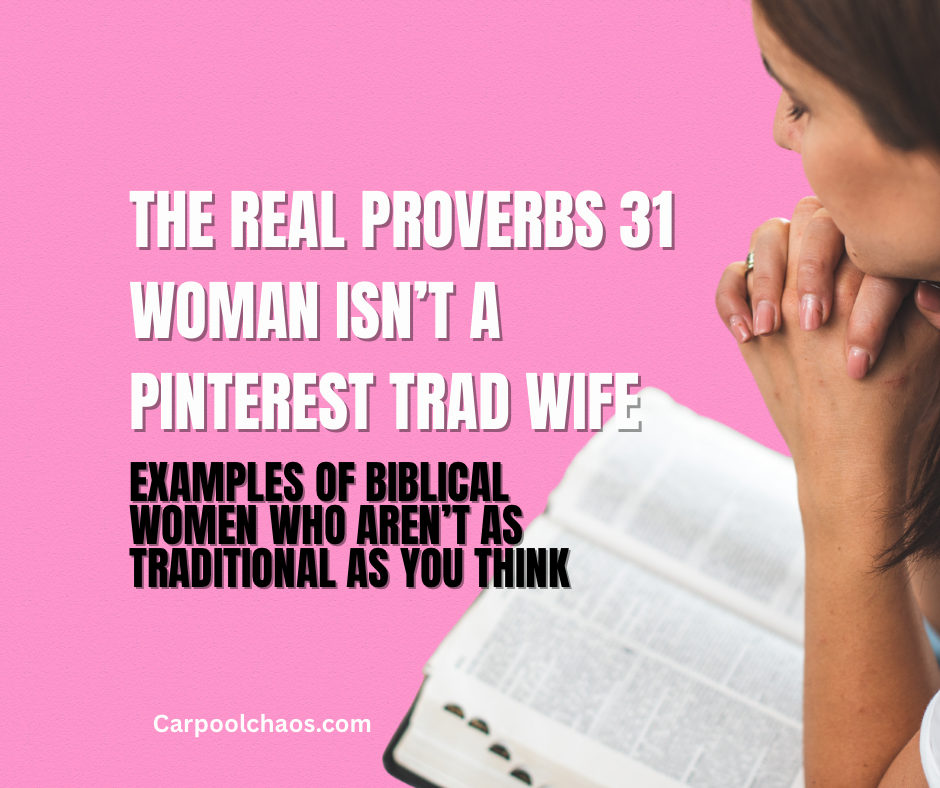
Why biblical womanhood has nothing to do with sourdough perfection and everything to do with courage, strength, and the warrior-hearted women of Scripture.
Ladies! Can we talk about something serious? I promise I’ll get back to the funny in a bit. But I think we need to have a chat about biblical womanhood for a minute?
Because somewhere along the way, the idea of being a Proverbs 31 woman turned into:
- a trad wife with perfect barrel curls,
- a 200-square-foot garden producing gourmet meals,
- handmade sourdough loaves shaped like woodland creatures,
- angelic children in linen aprons,
- and a spotless house that looks like Joanna Gaines staged it between commercial breaks.
If that’s your life — congratulations. Sincerely. Write a book. Teach a class. Adopt me.
But for the rest of us?
We wake up at 5:30 a.m. looking like a feral raccoon who lost a bar fight with a possum, clutching yesterday’s cold coffee (the one we reheated twice but still forgot to drink), trying to shove kids out the door while muttering prayers that sound holy but feel desperate.
My best “biblical womanhood” moment this morning was realizing I was wearing a shoe with absolutely no sole, just one, and deciding that the Lord Himself could sort it out later.
But here’s the thing:
Biblical womanhood was never about perfection.
Or appearance.
Or aesthetics.
Or curated domestic bliss.
It was about strength, grit, courage, wisdom, leadership, faithfulness, and showing up.
Pinterest did not invent biblical femininity — God did.
And His version looks nothing like the trad-wife highlight reel.
Let’s talk about it.
📜 Proverbs 31 Was Never a To-Do List
Proverbs 31 has been turned into:
“Here, ladies, complete this impossible list daily or you’re failing at womanhood.”
But in Hebrew culture, this wasn’t a job description — it was a praise song.
A poem.
A celebration of women’s strength, agency, work, business, wisdom, and spiritual leadership.
The phrase “virtuous woman” (or “woman of noble character”) is actually eshet chayil — meaning:
- woman of strength
- woman of valor
- warrior-hearted woman
Not: woman of perfectly clean home and beautiful baked goods.
👑 Esther — Braver Than Pinterest Will Ever Show
Esther didn’t win “Wife of the Year.”
She won “I Might Die Doing This but My People Need Me.”
She wasn’t quiet.
She wasn’t meek.
She used strategy, political influence, boldness, and intelligence to save a nation.
She literally said,
“If I perish, I perish.”
Biblical womanhood is courage under pressure.
🌾 Ruth — Loyalty, Grit, and Showing Up on the Hard Days
Ruth worked in dusty fields, broke a sweat, supported her mother-in-law after husband died, and chased God with her whole heart.
Her life wasn’t aesthetic.
It was obedient, humble, hardworking, and devoted.
Boaz didn’t marry Ruth because she had a perfect collection of canned goods while looking like a model.
The Bible says he inquired about her character. He saw her work and her heart and that moved him.
⚔️ Deborah — The Judge, The Leader, The Warrior
Deborah wasn’t sitting quietly in the corner stitching doilies.
She ran a nation.
She led armies.
She delivered prophetic direction.
She held court under a tree and settled legal disputes like the actual Supreme Court of Israel.
When the men hesitated, Deborah said,
“Get up. God already told you what to do.”
Biblical femininity includes leadership — spiritual, emotional, and sometimes literal.
🪓 Jael — The Woman Who Ended a Battle With a Tent Peg
If you think biblical womanhood is always gentle…
Let me introduce you to Jael.
Sis saw an enemy commander.
Invited him in.
Gave him milk.
Waited until he fell asleep.
And then said,
“Not today, Satan,” and handled business with a tent peg and a hammer.
She secured Israel’s victory.
Jael wasn’t soft.
She was decisive. Brave. Unshakeable. Tactical.
Biblical womanhood sometimes means spiritual warfare — not perfect tablescapes.
- When “Know-It-All” Becomes an Identity: What Apollos and a Snarky Comment Taught Me About Humility
 Have you ever been called a know-it-all? You don’t have to hide your intelligence. Discover what the story of Apollos teaches about humility, teachability and using God’s gifts with love.
 - 💎 The Bracelet That Changed the Way I See People
 A lost friendship bracelet reminded me that every person is priceless to God. A Christian devotional about the Good Samaritan, compassion and seeing people through Jesus’ eyes.
 - 🌪️ When Your Saturday Falls Apart (and God Still Provides)
 Have you ever felt like everything fell apart before lunch? Discover how the widow of Zarephath reminds us that God’s daily provision is always enough.
 - When a Bologna Sandwich Nearly Broke Me
 A simple lunch turned into a lesson on exhaustion, grace and God’s invitation to rest. From Elijah under a broom tree to David’s green pastures to my chaotic kitchen, God meets weary hearts wherever they are.
 - Rivals Can’t Have Revival
 What if the greatest barrier to revival isn’t the culture—but the Church? Discover why Jesus prayed for unity and why rivals don’t build God’s Kingdom… they destroy it.
🧠 Priscilla — Theology Teacher, Church Planter, Husband’s Partner
Priscilla taught Apollos — a male preacher — the ways of God more accurately.
She traveled.
She planted churches.
She did ministry shoulder-to-shoulder with her husband, as an equal.
Biblical womanhood includes wisdom, teaching, partnership, and calling.
Not shrinking.
Not silencing.
Not “staying in your corner.”
💡 The Word ‘Helper’ Doesn’t Mean What People Think
In Genesis, God says He will make Adam a “helper” — an ezer kenegdo.
People interpret “helper” as:
assistant
sidekick
maid
junior partner
But in Hebrew?
Ezer = lifesaver. warrior. strong protector.
Kenegdo = corresponding to, equal, alongside.
The same word ezer is used for God Himself:
“God is our help.”
“The Lord is our helper.”
“My help comes from the Lord.”
God is not our maid.
God is not our assistant.
God is not less than us.
So why would “helper” imply women are?
It means:
Women were created as strength beside strength.
Warriors beside warriors.
Lifesavers beside lifesavers.
Not subordinates.
Not accessories.
Not homemaking trophies.
🌪️ So What Is Biblical Womanhood, Really?
I’m not saying “don’t try.” I’m saying try to be what God called you, not the influencer your followers, to be. Have some grace for yourself when things don’t go right or look perfect.
Biblical womanhood is:
- courageous like Esther
- loyal like Ruth
- wise like Deborah
- fierce like Jael
- learned like Priscilla
- strong like the Proverbs 31 woman
- protective like God
- created equal like the ezer kenegdo
- resilient, faithful, determined, steady
It is not quiet perfection —
it is Holy Spirit-fueled strength.
And whether you’re:
- running a newsroom,
- wrangling kids,
- microwaving the same coffee three times,
- breaking up fights over cereal,
- or stumbling out the door wearing two different shoes…
You are still a woman of valor.
Eshet chayil.
A warrior.
A lifesaver.
Made by God for strength.
Love God. Love your husband and kids. Love others. Love yourself.
Pinterest can keep its pin perfect ideals of being a woman, a wife, and a mother.
I’ll take the biblical version any day.
🙏 Guided Prayer
Lord, thank You for creating women with strength, courage, and purpose.
Help me shake off the false expectations I’ve absorbed—perfection, comparison, pressure, and the lie that biblical womanhood means shrinking.
Teach me to walk boldly like Esther, work faithfully like Ruth, lead confidently like Deborah, fight bravely like Jael, teach wisely like Priscilla, and live with the grounded strength of the Proverbs 31 woman.
Remind me that You created me as an ezer kenegdo—a warrior beside warriors, a lifesaver, a reflection of Your own strength.
Make me a woman of valor in my home, work, and community. Amen.
🪜 Devotional Action Steps
1️⃣ Reclaim the meaning of “helper.”
Write “EZER KENEGDO = LIFESAVER” somewhere you will see it.
Let it shift how you see your calling.
2️⃣ Read one biblical woman’s story today.
Choose Esther, Ruth, Deborah (Judges 4–5), Jael (Judges 4:17–22), or Priscilla (Acts 18).
Ask: What strength did she show that I need today?
3️⃣ Identify one unfair expectation you’ve been carrying.
Maybe it’s a spotless house. Maybe it’s being everything to everyone.
Release it. Out loud.
4️⃣ Speak “Eshet Chayil” over yourself.
This means: Woman of valor.
Say it on the hard days—especially when you feel like a raccoon in mismatched shoes.
5️⃣ Do one brave thing this week.
Have the conversation.
Set the boundary.
Say yes to the calling.
Say no to the pressure.
Something that honors the warrior God created you to be.
Leave a Reply